
As our climate shifts, the need for long-term, evidence-based tree selection becomes ever more pressing. This article explores how climate modelling can help inform future-proof planting strategies— ensuring our treescapes thrive not just today, but decades from now.
At the time of writing, we’ve seen just 4 mm of rainfall in March, making it the driest, warmest, and sunniest March on record. Conditions like this have serious implications for trees in our streets, parks, gardens, and collections. Trees planted today may still be growing in 2100 by which time the climate they inhabit could be vastly different. Tools like climate models can help us make informed decisions about which species are most likely to succeed under future conditions.
A tree’s success in any location is shaped by a complex mix of environmental factors especially temperature, water availability, and soil characteristics. As these shift outside of a species’ comfort zone, growth slows and stress increases. Urban trees face even greater challenges. The urban heat island effect raises local temperatures and intensifies drought stress. Trees may close their stomata during heatwaves to conserve water halting the cooling benefits they typically provide. In extreme cases, poorly adapted trees can even worsen local heating during the hottest parts of the day.
To build more resilient landscapes, we must rethink species selection with tomorrow’s climate in mind
Over the past few decades, the UK has grown warmer, wetter, and sunnier. While this may sound benign, it means that extreme weather events like summer droughts are becoming more intense and unpredictable. Urban trees already contend with compacted soils, limited rooting space, and restricted water access. In the future, these challenges are likely to intensify. As a result, some of the trees we plant today may struggle or even fail in the decades to come. To build more resilient landscapes, we must rethink species selection with tomorrow’s climate in mind.
Species Distribution Models (SDMs) are increasingly used to evaluate where a tree species is likely to thrive—both now and in the future. These models work by comparing a tree’s environmental preferences with current and projected climate conditions. One particularly useful metric is the Climate Moisture Index (CMI). Unlike rainfall alone, CMI accounts for both precipitation and temperature offering a more accurate picture of water availability. This is especially relevant in warmer climates, where high evaporation can offset rainfall gains.
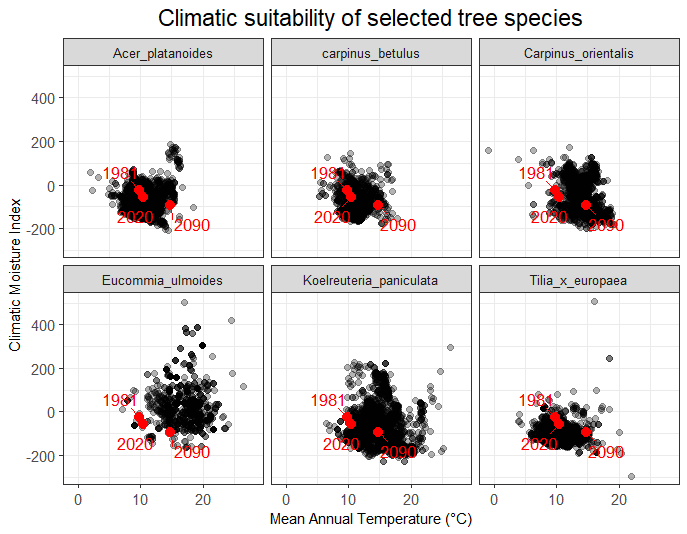
We recently applied this approach to the Royal Botanic Gardens, Kew, an internationally renowned site located within a strong urban heat island. Using CMI modelling, we evaluated six tree species based on their drought tolerance and suitability under current and projected conditions. The model compared environmental conditions in 1980, 2020, and 2090 under a high-emissions climate scenario, focusing on Mean Annual Temperature and CMI. The results highlight which species are likely to thrive at Kew in the future and which may face mounting challenges as moisture stress increases.
Recent years have brought record-breaking heat globally, pushing us closer to the 1.5°C threshold. If we continue to plant trees based on historical conditions, we risk creating fragile, short-lived landscapes. By using tools like SDMs and CMI, we can make more resilient, climate-aware choices —ensuring that today’s plantings remain assets for decades to come.
Figure 1. Climatic suitability of selected tree species based on Mean Annual Temperature (MAT, °C) and Climatic Moisture Index (CMI). Each panel represents a different species (Acer platanoides, Carpinus betulus, Carpinus orientalis, Eucommia ulmoides, Koelreuteria paniculata, and Tilia × europaea). Background black dots represent species occurrence points, showing their climatic envelope. Blue points indicate the climatic conditions for the years 1981, 2020, and projected 2090 conditions at a specific location. The spread of occurrence data provides insight into each species' climatic tolerance, while the future projections illustrate potential shifts in suitability under climate change scenarios.
As climate change reshapes our environment, choosing the right trees for future conditions is more important than ever. This article explores how climate modelling tools like the Climate Moisture Index (CMI) can guide smarter, future-proof tree selection. Using a case study from the Royal Botanic Gardens, Kew, it demonstrates how modelling can highlight which species are most likely to thrive as temperatures rise and moisture availability shifts. By embracing these tools, we can ensure today’s plantings remain resilient, sustainable, and beneficial for generations to come.
About the author
Kevin Martin serves as the Head of Tree Collections at the Royal Botanic Gardens Kew, where he shoulders the vital responsibility of curating the tree collection. Charged with safeguarding the future of the collection amid the dynamic landscape of climate change, Kevin’s passion lies in comprehending its impact on trees and pioneering methods to pinpoint species resilient to forthcoming environmental shifts.
Currently pursuing a research master’s degree at the University of Lancaster, Kevin focuses on species distribution modelling and future climate projections. By embracing data-driven approaches, he aims to revolutionize tree selection strategies, ensuring that Kew Gardens remains at the forefront of botanical conservation. Through his academic pursuits, Kevin aspires to integrate cutting-edge methodologies to fortify the resilience and sustainability of Kew’s botanical collections in the face of increasingly complex environmental challenges.